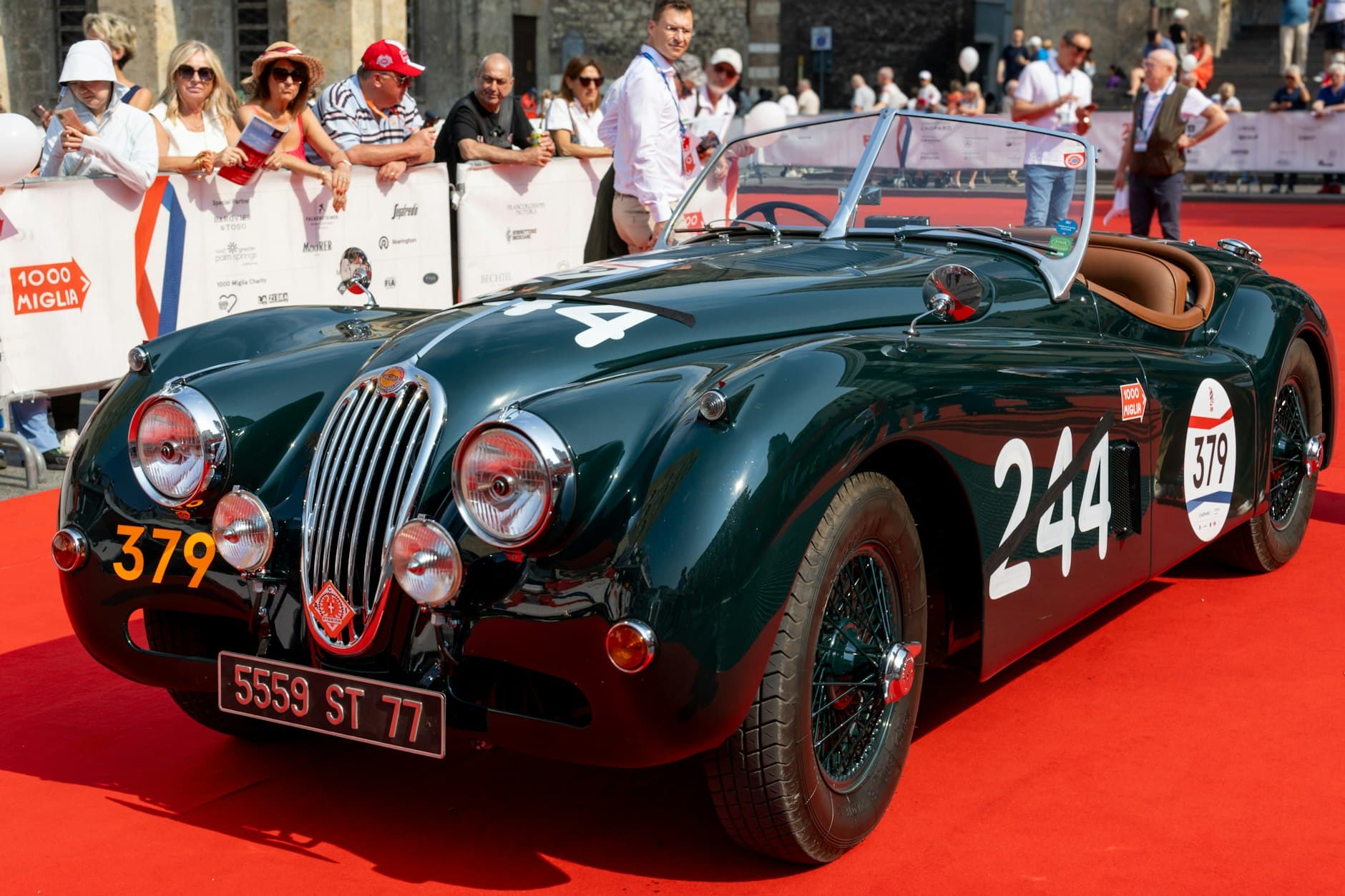
The Jaguar D-Type won the Le Mans 24 Hours three years running, from 1955 to 1957, and it is now the most valuable British car ever sold at auction. Aerodynamicist Malcolm Sayer shaped it, its tail fin and aircraft-style construction were years ahead of rivals, and in 2016 a race-winning example changed hands for 21.78 million dollars. It is the competition sibling of the road car that made Jaguar famous.
Why did the Jaguar D-Type win Le Mans three times?
It won because it was faster through the air and better at stopping than anything else on the grid. Malcolm Sayer gave the D-Type a slippery body and a stabilising tail fin for the long Mulsanne straight, and Jaguar fitted Dunlop disc brakes, which let the car brake later and harder than its drum-braked rivals lap after lap.
The wins came in 1955, 1956 and 1957, the last two taken by the privateer Scottish team Ecurie Ecosse rather than the factory. In 1957 D-Types finished first, second, third, fourth and sixth, one of the most complete victories in the history of the race.
| Year | Winning drivers | Team | Note |
|---|---|---|---|
| 1955 | Mike Hawthorn / Ivor Bueb | Jaguar works | Won amid the sport's darkest day |
| 1956 | Ron Flockhart / Ninian Sanderson | Ecurie Ecosse | Privateer Scottish team wins |
| 1957 | Ron Flockhart / Ivor Bueb | Ecurie Ecosse | D-Types took five of the top six |
Who designed the Jaguar D-Type?
Malcolm Sayer designed the D-Type, the same aerodynamicist who would later shape the Jaguar E-Type. He had come from the aircraft industry and worked with mathematics and wind-tunnel logic rather than a stylist's eye, which is why the D-Type looks engineered rather than merely drawn.
The construction was as advanced as the shape. The centre of the car was a stressed monocoque tub, a technique borrowed from aviation and rare in racing at the time, with a tubular subframe carrying the engine and front suspension. It made the car light, strong and stiff, and it pointed directly at how road cars would be built decades later.
What is the D-Type's link to the 1955 Le Mans disaster?
The D-Type won the 1955 race, but that year is remembered for the worst accident in motorsport history rather than the result. On lap 35 a chain of events sent a Mercedes-Benz 300 SLR into the crowd, killing more than eighty spectators, and Mercedes withdrew from the race and then from racing altogether.
Jaguar stayed in and Mike Hawthorn's D-Type took the win, a victory forever shadowed by the tragedy around it. The disaster reshaped safety at Le Mans and across the sport, and it links the D-Type's proudest era to the darkest day the circuit has known.
How much is a Jaguar D-Type worth?
A race-winning D-Type is worth tens of millions, and one holds a specific record. In 2016 the 1956 Le Mans winner, the Ecurie Ecosse car chassis XKD501, sold through RM Sotheby's at Monterey for 21.78 million dollars, the highest price ever paid at auction for a British car.
Rarity supports those numbers, since Jaguar built only around 71 D-Types in total. History does the rest, exactly as our guide to what makes a classic car worth millions describes, and a documented Le Mans winner is the purest form of the provenance that ranks among the most expensive cars ever sold at auction.
What is the Jaguar XKSS?
The XKSS was the road-going version of the D-Type, a race car made just civilised enough for the street. Jaguar planned a run of them in 1957, but a fire at the Browns Lane factory that February destroyed several before they were finished, so only sixteen original cars were completed.
The story gained a coda decades later. In 2016 Jaguar built nine "continuation" XKSS cars by hand to replace exactly those lost in the fire, completing an order that had waited almost sixty years and making the model rarer and more coveted than ever.
Where does the D-Type sit in the quiet-luxury canon?
The D-Type belongs through engineering rather than comfort, a pure racer collected for what it did and how it was made. Its beauty is a by-product of function, the same quality that makes Sayer's later E-Type so admired, and that honesty is exactly the taste this canon rewards.
It also carries a weight few cars can, a genuine three-time Le Mans winner with a record price and a place in the sport's history. Owning one is owning a chapter of motor racing, which is why it stands with the very best regardless of how quietly it does so.
Frequently asked questions
How many times did the Jaguar D-Type win Le Mans? Three times in a row, in 1955, 1956 and 1957, the last two victories taken by the privateer Scottish team Ecurie Ecosse.
What is the most expensive Jaguar ever sold? The 1956 Le Mans-winning D-Type, chassis XKD501, sold for 21.78 million dollars at RM Sotheby's in 2016, a record for any British car at auction.
What is the difference between the D-Type and the XKSS? The XKSS is the road-legal version of the D-Type race car; only sixteen originals were built in 1957 before a factory fire ended production.