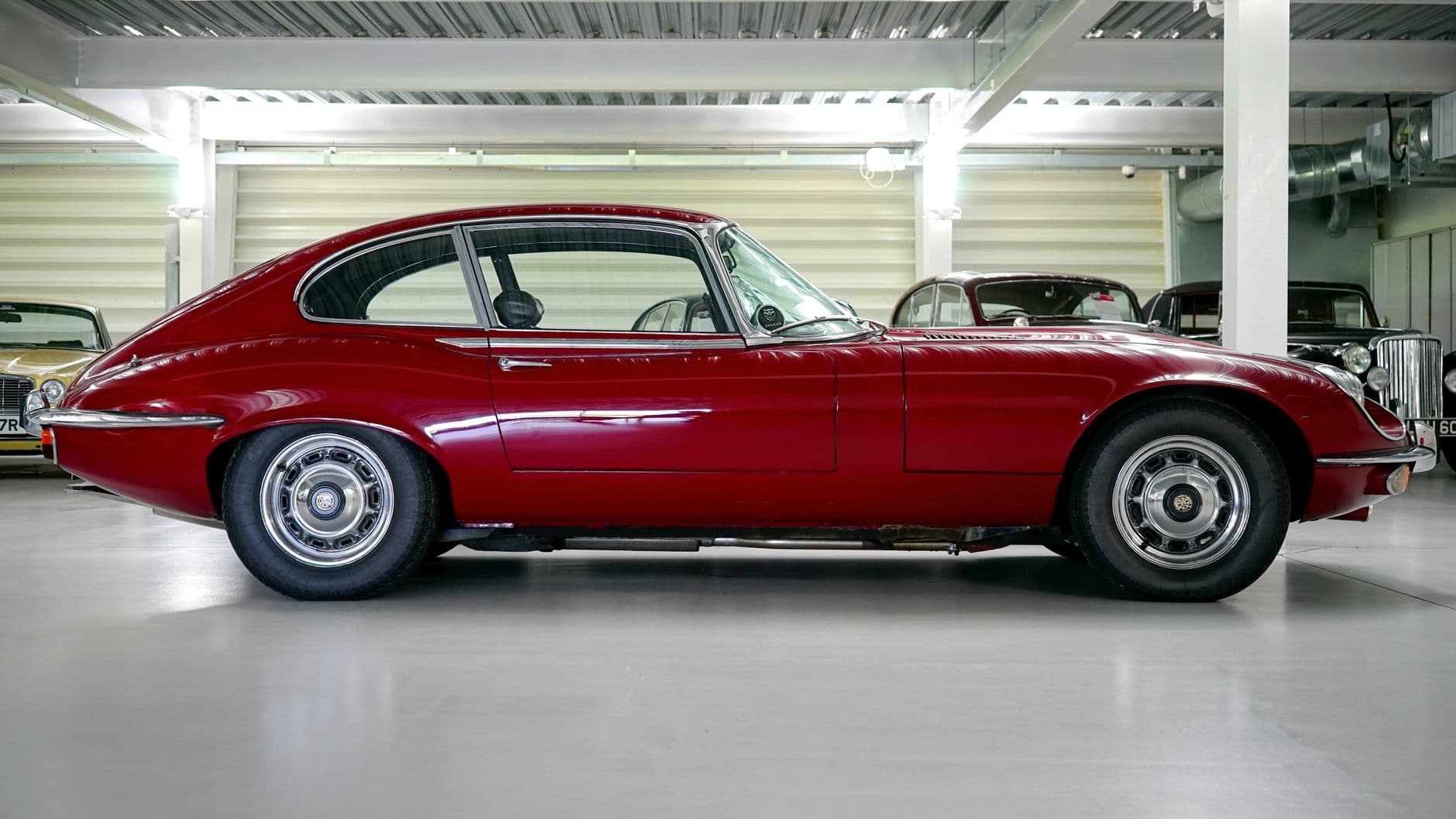
The Jaguar E-Type reached the public at the Geneva Motor Show in March 1961, and it made every rival on the stand look overpriced. It cost about £2,100, ran close to 150 mph, and looked like nothing else being built. Enzo Ferrari, who rarely praised other people's machinery, reportedly called it the most beautiful car ever made. Six decades on it sits in the permanent collection of the Museum of Modern Art, which tells you the E-Type was always more than transport.
Why did Enzo Ferrari call the E-Type the most beautiful car ever made?
Because it was drawn by an aerodynamicist, not a stylist. Malcolm Sayer had come from the Bristol Aeroplane Company, and he shaped the E-Type with mathematics and wind-tunnel logic rather than a designer's pen. The long bonnet, the faired-in headlights and the teardrop tail were not decoration; each curve followed a calculation.
Sir William Lyons, who founded Jaguar and had a sharp eye for a shape that would sell, signed it off. The launch itself became legend: Jaguar's test driver Norman Dewis drove the demonstrator known by its registration "9600 HP" overnight from Coventry to Geneva so the stand would have a second car for the press to try. The reception was immediate, and the coupe outshone cars costing three times as much.
What made the E-Type so fast for the money?
A 3.8-litre XK straight-six and a light body let it approach 150 mph for roughly half the price of a comparable Ferrari or Aston Martin. The engine produced a claimed 265 bhp, and it sat in a monocoque tub with a tubular subframe carrying the front suspension, a construction borrowed straight from racing thinking.
Two press cars, "9600 HP" and "77 RW", were road-tested at about 150 mph by British magazines in 1961, and the figure stuck to the whole range. In October 1964 Jaguar enlarged the engine to 4.2 litres, which added mid-range torque, a better gearbox and more comfortable seats without changing the silhouette. At £2,097 for the roadster, the E-Type undercut most of its rivals by a wide margin and still beat them to the horizon.
Which Jaguar E-Type is the most collectible?
The Series 1 3.8 roadster, and inside that group the earliest "flat-floor" cars built through 1962. Collectors prize the Series 1 for its covered headlights, slim bumpers and cleaner nose, the details that later safety rules would erode. The first few hundred cars had a flat floor and external bonnet latches, and those small features now carry a real premium.
| Series | Years | Engine | Signature detail | Collector standing |
|---|---|---|---|---|
| Series 1 | 1961–1968 | 3.8 / 4.2 six | Covered headlights, small mouth | Most desirable, esp. 3.8 flat-floor |
| Series 1.5 | 1967–1968 | 4.2 six | Open headlights, S1 body | Undervalued middle ground |
| Series 2 | 1968–1971 | 4.2 six | Wraparound bumpers, bigger grille | Usable, more affordable entry |
| Series 3 | 1971–1975 | 5.3 V12 | Flared arches, long wheelbase | Rising, prized in roadster form |
Across all four series Jaguar built roughly 72,500 cars, so the E-Type is collectible without being rare. That balance keeps a running example within reach while the best cars climb, much as the earliest examples of the Lamborghini Miura pulled away from later ones.
How much is a Jaguar E-Type worth at auction today?
A well-sorted Series 1 3.8 roadster generally trades between $150,000 and $250,000, while the aluminium racing Lightweights reach several million dollars. Values tracked by collector-car insurer Hagerty put concours Series 1 roadsters at the top of the road-car range, with fixed-head coupes and Series 2 cars costing noticeably less (checked July 2026).
Provenance changes everything. Only twelve Lightweight E-Types were built in 1963 and 1964, and Jaguar completed the six "missing" chassis as continuation cars in 2014, which is why an original crosses the block at Ferrari money. Houses such as RM Sotheby's and Bonhams treat a documented racing E-Type the way they treat the entries on our list of the most expensive cars ever sold at auction, where history counts for more than horsepower.
Where does the E-Type fit in the quiet-luxury canon?
It is one of the few cars collected as much for its shape as its speed. The Museum of Modern Art in New York added a 1963 roadster to its permanent design collection in 1996, one of a small handful of cars the museum has ever accepted as design objects rather than machines. That single decision says why the E-Type belongs beside a Ferrari 250 GTO in any collection built on taste rather than noise.
The E-Type asks for nothing loud. It is fast, restrained and beautifully proportioned, the same qualities that make the Mercedes-Benz 300 SLR so admired, and the reason sculptors keep returning to its form. Antoine Dufilho's layered-steel studies of cars like this one work precisely because the original shape already reads as art standing still.
Frequently asked questions
Is the Jaguar E-Type a good investment? The Series 1 3.8 roadster has held and grown its value for years, but running and restoration costs are high, so buy the best documented car you can and treat any gain as a bonus.
How many Jaguar E-Types were made? Jaguar produced about 72,500 across Series 1, 2 and 3 between 1961 and 1975, split between roadsters, fixed-head coupes and the longer 2+2.
Why is the E-Type also called the XK-E? It is the same car under a different name; Jaguar marketed it as the XK-E in the United States, its largest market, while the rest of the world knew it as the E-Type.


