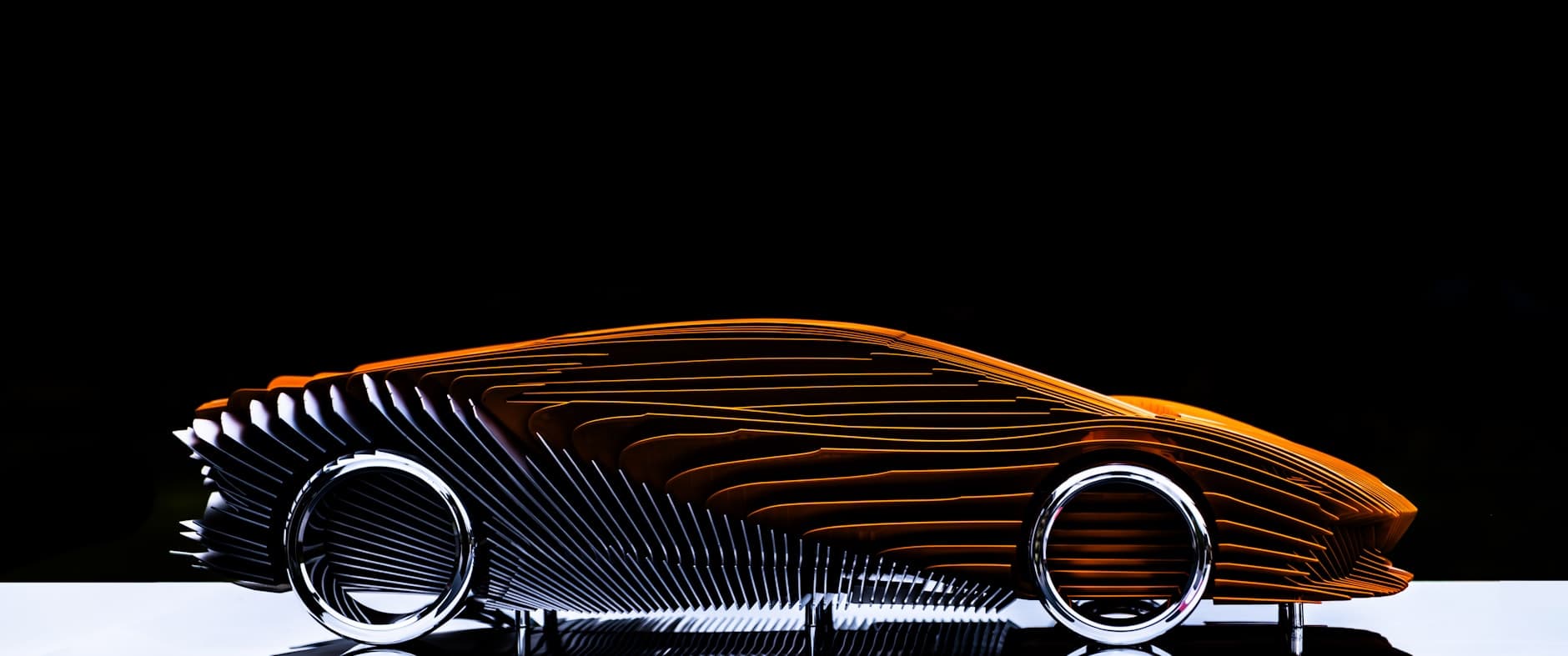
Antoine Dufilho is the French sculptor who turns famous cars into stacked metal, and the result seems to move even though nothing does. He cuts steel and aluminium into profiles, layers them with gaps between each sheet, and builds a car that looks solid from one angle and dissolves into speed from another. It is the automobile treated as a piece of art, which is the idea this site was built around.
Who is Antoine Dufilho?
Antoine Dufilho is a self-taught French sculptor who has worked full time in sculpture since 2012. He came to art without a formal fine-art training and developed his own language rather than inheriting one, which is part of why the work looks unlike traditional bronze or marble.
His subjects are almost always machines that already carry design ambition: automobiles above all, and aircraft alongside them. He does not sculpt ordinary cars but the icons, the shapes that were already considered beautiful before anyone thought to hang them on a wall or set them on a plinth.
How does Dufilho create the illusion of motion?
He builds the car from layered sheets of metal separated by voids, so the eye reads speed as it moves around the piece. Each sheet is a cross-section of the car, and the gaps between them let light through, so a solid form appears to blur, gather and dissolve depending on where you stand.
The effect is kinetic without any moving parts. The viewer supplies the movement, walking past the sculpture the way you would watch a car pass, and the layered structure turns that walk into an animation.
| Technique element | What it does | Effect on the viewer |
|---|---|---|
| Layered sheets | Each is a slice of the car's form | Reads as a solid body head-on |
| Voids between layers | Let light pass through the mass | The car appears to dissolve at an angle |
| Steel and aluminium | Hold a precise cut edge | Sharp lines suggest airflow and speed |
| The viewer's movement | Changes the angle of sight | Turns a static object into motion |
The method is closer to drawing in space than to carving. Dufilho removes material to imply a shape rather than piling it on, so the sculpture is defined as much by the air inside it as by the metal.
Why sculpt cars at all?
Because the car has been treated as art for more than a century, and Dufilho works squarely in that tradition. In 1909 the Italian writer Filippo Tommaso Marinetti opened the Futurist movement by declaring a racing car "more beautiful than the Victory of Samothrace", setting the machine above classical sculpture for the first time.
The Futurists then tried to put speed itself into solid form, most famously in Umberto Boccioni's 1913 bronze "Unique Forms of Continuity in Space", a striding figure that seems to move while standing still. Dufilho pursues the same goal a century later, only his subject is the object the Futurists worshipped from the start: the car.
Which cars translate best into sculpture?
The cars with the strongest, cleanest forms make the strongest sculptures, which is why the icons recur. A shape that already reads as art in metal, such as the Jaguar E-Type that the Museum of Modern Art collects as design, gives the layered treatment something worth slicing.
The same is true of a competition Ferrari or a silver-era Mercedes. The Ferrari 250 GTO and the Mercedes-Benz 300 SLR were drawn for speed, and a sculptor who works in speed finds their curves already halfway to abstraction.
What makes automotive sculpture collectible?
Collectors buy automotive sculpture for the same reasons they buy the cars: form, rarity and the pleasure of owning a designed object. A sculpture asks nothing of a garage and never needs an engine rebuild, yet it holds the same shape that makes people pay millions for the real thing.
It also sits at a crossroads that few pieces occupy, welcome in both an art collection and a car collection. For anyone who values the ideas set out in our guide to what makes a classic car worth millions, a sculpture offers the design without the depreciation, provenance or paperwork.
Frequently asked questions
What technique does Antoine Dufilho use? He layers cut sheets of steel and aluminium with voids between them, so the car reads as solid head-on and appears to dissolve into motion when viewed from an angle.
Is Antoine Dufilho formally trained? No. He is a self-taught sculptor who has worked full time in the medium since 2012 and developed his layered method independently.
What does Dufilho sculpt besides cars? Aircraft are his other main subject, and like the cars they are machines built for speed, which suits his method of freezing movement in metal.