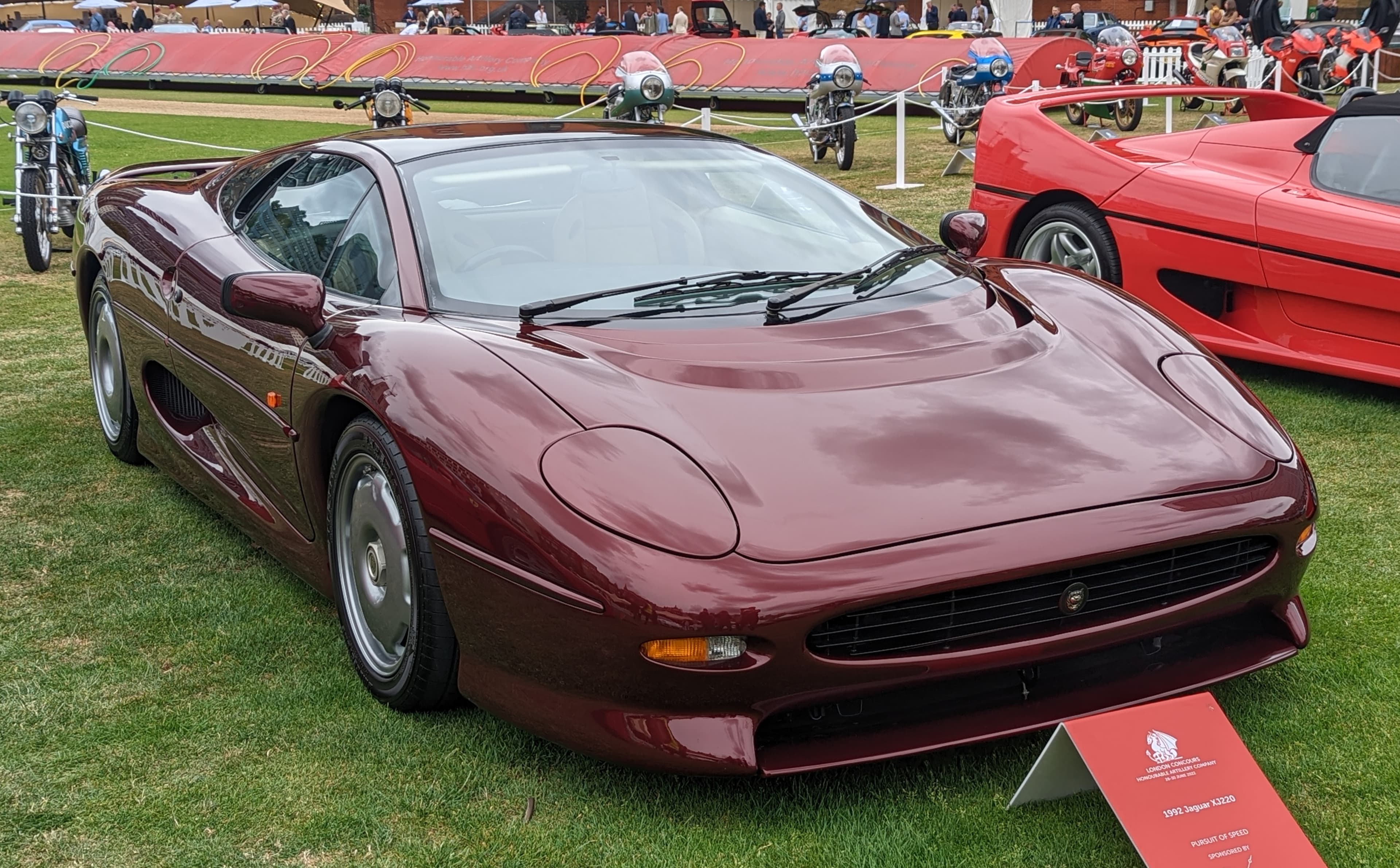
1992 Jaguar XJ220. Image: Calreyn88, Wikimedia Commons (CC BY-SA 4.0).
The Jaguar XJ220 was the fastest production car in the world when it arrived in 1992, and its own buyers sued to get out of buying it. Promised a V12 and all-wheel drive, they were handed a twin-turbo V6 that drove only the rear wheels, then hit by a recession, and many walked away. The car that was dumped for a quarter of its price is now the cheapest way into the 1990s analog-supercar club, and it is climbing. This is one of the great redemption stories in collecting.
This piece covers the XJ220 on its own terms and links to the rivals iconcar profiles separately. Figures come from Jaguar, RM Sotheby's, Hagerty and Wikipedia, and were checked in August 2026. Where two numbers circulate, it says which is which.
What is the Jaguar XJ220?
The XJ220 is a mid-engined supercar built from 1992 to 1994 by JaguarSport, the joint venture between Jaguar and Tom Walkinshaw Racing. Just 281 were made at a dedicated factory in Bloxham, Oxfordshire, which afterwards went on to build the Aston Martin DB7. For a brief window it was the fastest road car on earth, quicker than the Ferrari F40 and the Porsche 959.
It began as an after-hours passion project. A group of twelve Jaguar engineers, nicknamed the Saturday Club and led by Jim Randle, built a stunning V12 concept for the 1988 Birmingham Motor Show. The reaction was so strong that Jaguar put it into production, and that is where the trouble started, because the car that reached customers was not the car they had fallen for.
How fast was the XJ220, and did it hit 220 mph?
Not quite 220, but fast enough to take the world record. At the Nardo test track in June 1992, Martin Brundle recorded 212.3 mph in a standard car and 217.1 mph once the catalytic converters were removed and the rev limit raised. The 217.1 mph run is the one logged as the production-car record, and the "220" in the name was always the design target rather than a promise.
Either figure was enough to humble the competition. The XJ220 comfortably beat the Ferrari F40 at around 201 mph and the Porsche 959 at around 197 mph, and it held the fastest-production-car title until the McLaren F1 took it in 1994. The racing version, the XJ220-C, even won its class at Le Mans in 1993, only to be stripped of the result after the race on a technicality.
Why were the buyers so angry?
Because the production car broke the promise of the concept. The 1988 show car had a 6.2-litre naturally aspirated V12, all-wheel drive, four-wheel steering and scissor doors. The 1992 production car had a 3.5-litre twin-turbo V6, rear-wheel drive, ordinary doors, and a shorter body. To the roughly 1,500 people who had put down 50,000-pound deposits, it felt like a different car.
The recession of the early 1990s turned disappointment into revolt. Many deposit-holders, a good number of them speculators, refused delivery and sued, arguing the switch from V12 to V6 voided their contracts. It did not. The contracts signed in December 1989 already specified the V6 and rear-wheel drive, so the courts found the delivered car matched what buyers had actually agreed to, and Jaguar won. The betrayal was of expectation, not of the small print.
What engine does the Jaguar XJ220 have?
A 3.5-litre twin-turbocharged V6, and it was the better engine, whatever the buyers felt. The unit traces back to the V6 that Cosworth designed for the MG Metro 6R4 Group B rally car; TWR bought the rights in 1989 and turned it into a twin-turbo making 542 bhp, an engine already proven in Jaguar's Group C sports-racers. It was lighter than the promised V12 and helped the car to its record speed.
The rest of the engineering matched the ambition. The XJ220 used a bonded aluminium honeycomb chassis, weighed around 1,470 kg, and stretched almost five metres in length. The table sets out the figures that mattered.
| Jaguar XJ220 | Specification |
|---|---|
| Engine | 3.5L twin-turbo V6 (TWR, from the Metro 6R4 rally unit) |
| Power | 542 bhp (550 PS) at 7,200 rpm |
| Top speed | 212.3 mph standard / 217.1 mph record (Nardo, 1992) |
| Chassis | Bonded aluminium honeycomb, rear-wheel drive |
| Built | 281 cars, 1992–1994, by JaguarSport (Bloxham) |
| Launch price | ~£400,000 (about £470,000 on the road) |
How much is a Jaguar XJ220 worth now?
A good XJ220 sits around 400,000 pounds, or roughly 460,000 to 580,000 dollars, and the trend is up. That is a long way back from the bottom. The last unsold cars were cleared in 1997 for a fraction of list, and by the mid-2000s even low-mileage examples changed hands for 120,000 to 170,000 dollars, pennies against their original price. Hagerty later recorded a 20% climb in just two years as the market re-appraised the car.
The recent results confirm the recovery. A 304-mile 1993 car made 582,500 dollars at RM Sotheby's Monterey in 2025, and 2024 and 2026 sales have clustered from the mid-400,000s to well over 500,000 dollars. The rare TWR-built XJ220S, of which only a handful exist, has reached around a million. The table tracks the arc from flop to blue-chip.
| XJ220 value | Figure |
|---|---|
| 1997 clearance (last cars) | ~a quarter of list price |
| Mid-2000s trough | ~$120,000–$170,000 |
| Typical today (2026) | ~£400,000 (~$460k–$580k) |
| TWR XJ220S (a handful built) | ~$1 million |
Why is the XJ220 the bargain of the analog supercars?
Because it does what its rivals do for a fraction of their price. The XJ220 is rarer than the Ferrari F40, outran both it and the Porsche 959, and comes from the same brief era of analog, pre-electronic supercars. Yet it trades at roughly a quarter of an F40, which now averages well over two million pounds, and a small fraction of a McLaren F1 or a Ferrari F50.
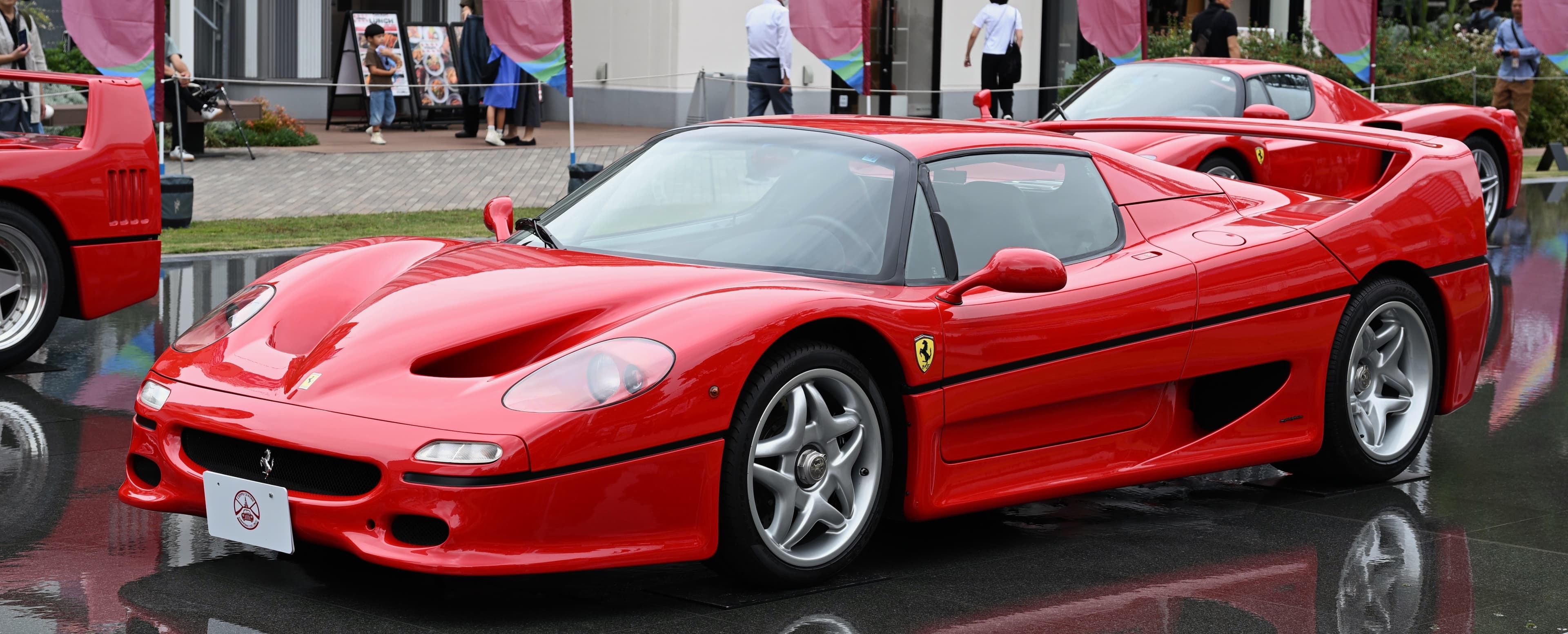
That gap is the opportunity, and the market has started to close it. The XJ220 sits in the same club as our deep-dives on the Ferrari F50, the Porsche 959 and the McLaren F1 GTR, and it is the one you can still buy for the price of a sensible garage rather than a house. The reasons it holds and grows in value, scarcity, performance and a story worth telling, are the same ones our guide to what makes a classic car worth millions keeps returning to, and its path fits the pattern we trace in classic car values in the EV era.
The lesson of the XJ220 is that the market eventually forgives. A car mocked at launch, sued over, and sold at a loss is now the thinking collector's entry into a world of seven-figure icons. Being disliked when new turned out to be the best thing that ever happened to its price.
Frequently asked questions
Was the Jaguar XJ220 really the fastest car in the world? Yes. In June 1992 it recorded 217.1 mph at Nardo, making it the fastest production car on earth, a title it held until the McLaren F1 beat it in 1994. A standard car managed 212.3 mph.
Why did the Jaguar XJ220 fail? The 1988 concept promised a V12 and all-wheel drive, but the production car arrived with a twin-turbo V6 driving the rear wheels. Combined with a recession and a rising price, many of the 1,500 deposit-holders refused delivery and sued, though the courts ruled for Jaguar.
Is the Jaguar XJ220 a good investment now? It has been one of the strongest re-appraisals in the market, climbing from a mid-2000s low near 120,000 dollars to around 400,000 pounds today. It remains far cheaper than the Ferrari F40, F50, Porsche 959 or McLaren F1 it once out-ran.