The Ferrari F50 is the closest a road car has ever come to being a Formula 1 car. Ferrari took the V12 that powered Alain Prost's 1990 grand prix car, enlarged it, and bolted it straight into a carbon-fibre tub with no turbos and no electronic aids. It built just 349, one fewer than it thought it could sell, and the car once written off as a flop now sells for more than the model it replaced. This is the story of the most literal race car Ferrari ever put on the road.
This piece stays with the F50 and treats the F40 only as a contrast, since iconcar covers that car separately. Figures come from Ferrari, Wikipedia, RM Sotheby's and Hagerty, checked in August 2026. Where a value is an auction outlier rather than a typical price, it says so.
What is the Ferrari F50?
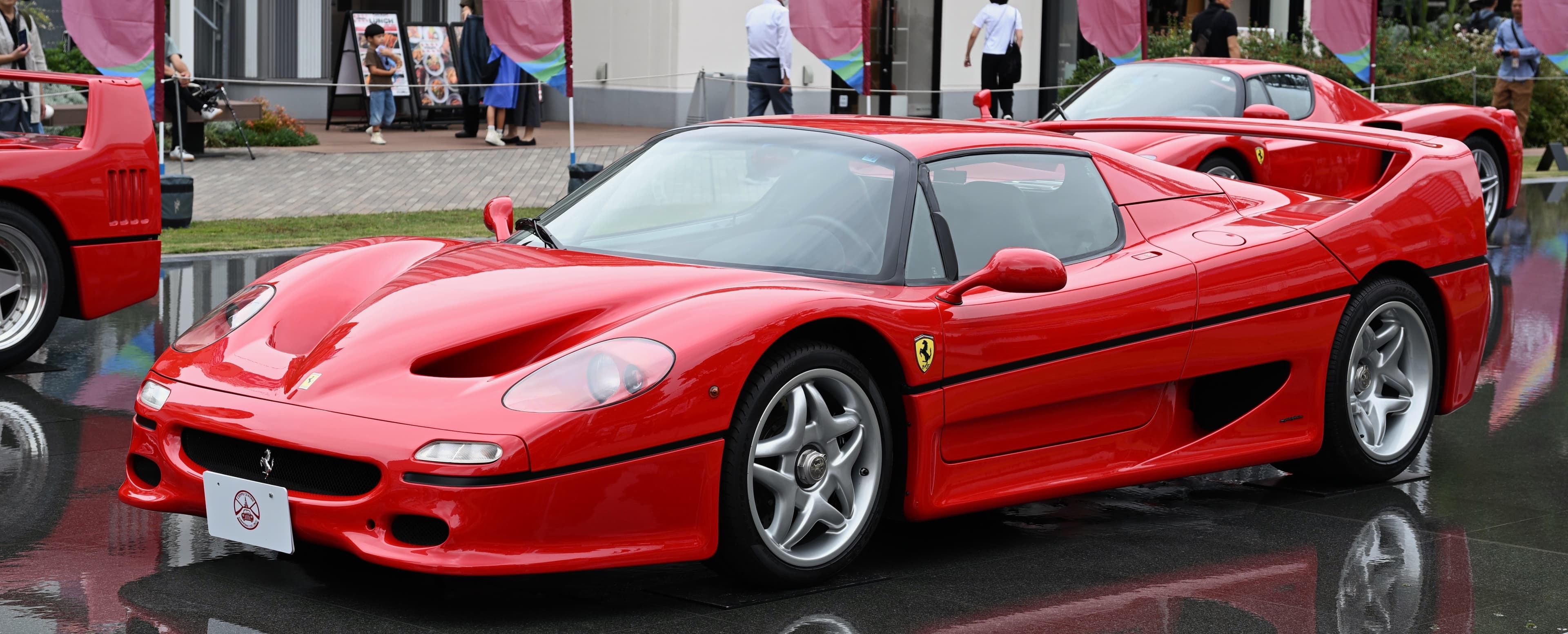
The F50 was the flagship Ferrari built for its 50th anniversary, produced from 1995 to 1997 in a run of 349 cars. It is the third of the marque's "Big Five" halo line, sitting between the F40 and the Enzo: 288 GTO, F40, F50, Enzo, LaFerrari. Luca di Montezemolo commissioned it with one brief, to bring the Formula 1 experience to the road, and Pininfarina styled it as a softer, 1990s reading of the F40's wedge.
Unlike the turbocharged F40, the F50 is naturally aspirated, open-topped and built around a Formula 1 idea rather than a road-car one. It is a targa with a removable hardtop, a full carbon-fibre tub, and no driver aids at all. There is no ABS, no traction control, no power steering and no power brakes, only a gated six-speed manual and a screaming V12 behind your shoulders.
Is the F50 really a Formula 1 car for the road?
More literally than any other Ferrari, yes. Its 4.7-litre V12 is descended from the 3.5-litre unit that took Prost's Ferrari 641 to five wins in the 1990 Formula 1 season, enlarged for the road and detuned from a screaming grand prix redline to a still-vivid 8,500 rpm. It makes around 520 PS, and it breathes through variable-length intake trumpets in the same spirit as the race engine.
The chassis borrows even more directly from the track. The F50 was Ferrari's first road car with a full carbon-fibre monocoque, and the engine is bolted to the back of that tub as a fully stressed member, exactly as a Formula 1 car carries its engine. The rear suspension then mounts to the gearbox, so there is no rear subframe at all. Ferrari's own claim is simple and, for once, close to true: the engine, the suspension and the carbon tub all came from Formula 1.
| Ferrari F50 | Specification |
|---|---|
| Engine | 4.7L naturally aspirated V12 (F1-derived), 60 valves |
| Power | ~520 PS (513 hp) at 8,500 rpm |
| Chassis | Full carbon-fibre monocoque; engine as stressed member |
| Gearbox | 6-speed gated manual, rear-wheel drive |
| Weight / top speed | 1,230 kg / 202 mph (claimed) |
| Built | 349 cars, 1995–1997 |
How is the F50 different from the F40?
The two cars answer the same question in opposite ways. The F40 chased speed with a twin-turbo V8; the F50 chased purity with a naturally aspirated V12. Without turbos, its throttle response is immediate and power builds to a howl near 8,500 rpm rather than arriving in a boosted surge. By the factory's own figures the F50 laps its Fiorano test track about three seconds faster than the F40, and it is far rarer, since only 349 were made against roughly 1,311 F40s.
This makes the F50 the only Ferrari flagship to pair an atmospheric V12 with a manual gearbox, the exact combination collectors now prize above all others. Where the Ferrari F40 is the last analog turbo icon, the F50 is the last analog V12 one, and it belongs with the fellow 1990s purists we cover in the McLaren F1 GTR and the Porsche 959.
Why did Ferrari build only 349?
Ferrari deliberately built one fewer car than it believed it could sell. Montezemolo announced the plan at the 1995 Geneva show: a run of 349, one short of the roughly 350 the market wanted, so that demand would always exceed supply. It was a direct answer to the F40, which Ferrari had built in the thousands and watched speculators flip for quick profit.
The control went further in America. There, Ferrari refused to sell the F50 outright, offering the 55 US cars on a mandatory two-year lease instead, with a large deposit, monthly payments and a final buyout that came to roughly 524,000 dollars. The whole point was to keep the cars in enthusiasts' hands and out of the flipping market. Scarcity, in other words, was engineered on purpose, a theme that runs through our guide to what makes a classic car worth millions.
What is a Ferrari F50 worth?
A good F50 sits around 3.65 million dollars, though the headline sales run far higher. Hagerty's guide puts a good-condition F50 near 3.65 million against about 2.55 million for an F40, so the F50 now commands a clear premium over the car it once lived in the shadow of. That is the number to hold in mind, because the records tell a wilder story.
Prices have spiked hard. The auction ceiling sat near 5.5 million dollars in early 2025, then a yellow ex-Ralph Lauren car made 9.245 million at RM Sotheby's, and by August 2026 a Giallo Modena example reached 14.575 million at Mecum's Monterey sale, the most expensive F50 ever. Those results are outliers, driven by rare colours, celebrity history and time-capsule mileage, so they should not be read as the price of an ordinary car. The table separates the everyday value from the record.
| F50 value | Figure |
|---|---|
| Good-condition guide (2026) | ~$3.65M |
| F40 good-condition guide (for contrast) | ~$2.55M |
| Auction ceiling, early 2025 | ~$5.5M |
| Record (Mecum Monterey, Aug 2026) | $14,575,000 |
Why was the F50 underrated, and why is it catching up?
For years the F50 was the least loved of Ferrari's supercars, and that is exactly why it now climbs. It was heavier than the F40, its styling divided opinion, and it arrived just before the Enzo stole the spotlight, so it spent two decades as the awkward middle child of the line. Enthusiasts who wanted an analog Ferrari bought the F40, and the F50 waited.
The re-appraisal came once collectors understood what it actually is. As turbos, paddle shifts and electronics took over, the F50's unturbocharged V12, gated manual and complete absence of driver aids turned from a footnote into the whole point, the same shift toward analog purity we trace in our look at the most expensive cars ever sold at auction. The car built to feel like a 1990s Formula 1 machine is now valued for being the last of its kind, and its once-modest price has followed. Ferrari, as it turns out, was right to make one too few.
Frequently asked questions
How many Ferrari F50s were made? Ferrari built 349, from 1995 to 1997, deliberately one fewer than the roughly 350 it believed it could sell. That is around a quarter of the 1,311 F40s made, which is a large part of why the F50 is now worth more.
Is the Ferrari F50 worth more than the F40? Yes, at every condition tier. Hagerty values a good F50 near 3.65 million dollars against about 2.55 million for an F40, and the F50's auction record stands at 14.575 million, set in August 2026.
What engine does the Ferrari F50 have? A 4.7-litre naturally aspirated V12 producing around 520 PS at 8,500 rpm, descended from the 3.5-litre V12 that powered Ferrari's 1990 Formula 1 car and enlarged for the road. It drives through a six-speed manual, the only such combination among Ferrari's flagship supercars.