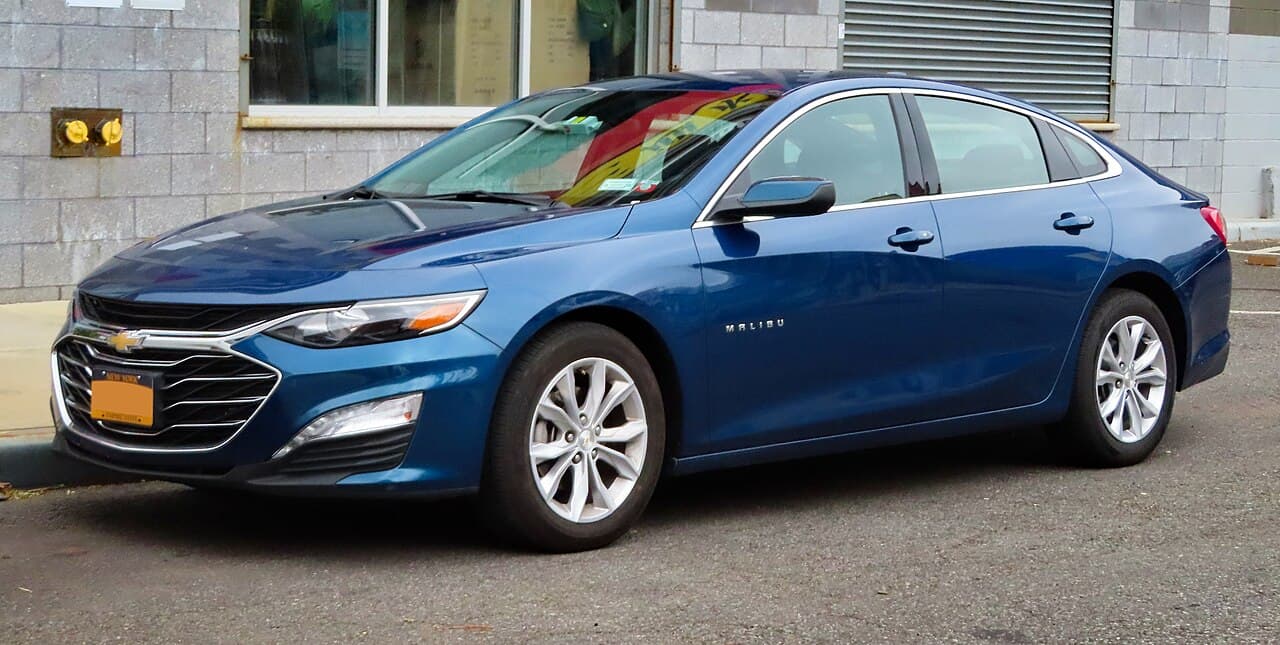
2019 Chevrolet Malibu. Image: Kevauto, Wikimedia Commons (CC BY-SA 4.0).
In November 2024 Chevrolet built its last Malibu, and with it, its last sedan. The name is 60 years old, and it began at the very top of the range on a muscle car now worth six figures. It ended on a fleet car that loses nearly half its value in five years and will be missed by almost no one. Same badge, opposite fates, and the whole logic of collecting sits inside that one nameplate.
This is not a nostalgic obituary. It is a look at why one car appreciates into a trophy while another depreciates into a rental-lot commodity, using the Malibu, which somehow managed to be both. Figures come from GM, CNN, Edmunds, Hagerty and Kelley Blue Book, checked in August 2026.
What happened to the Chevrolet Malibu?
General Motors ended Chevrolet Malibu production in November 2024, retiring the brand's last sedan after nine generations. The final cars were built at the Fairfax Assembly plant in Kansas City, which GM is spending around 390 million dollars to retool for the next Chevrolet Bolt EV, due to restart in late 2025. An ordinary petrol sedan was replaced, on the same line, by an electric car.
After the Malibu, Chevrolet's showroom holds trucks, SUVs and the two-seat Corvette, with no mainstream sedan left. The nameplate had sold more than 10 million cars worldwide since 1964. Its spokesman, Kevin Kelly, put it plainly: the Malibu had been "a stalwart offering for nine generations," but buyers had moved to compact SUVs, "now the largest segment in the US."
Why did GM kill the Malibu?
It was killed by demand, margins and electrification at once, not by any fault of the car. Americans stopped buying sedans, and the money moved to SUVs and to EV factories. Chevrolet sold 227,881 Malibus in 2016, its modern peak; by 2024 that had fallen to 117,319, roughly half. Worse for a retail model, more than half of late Malibus went to rental fleets, reaching around 75% in some months of 2023.
That fleet dependence is the tell. A car bought in bulk to be used up, rather than chosen and kept, is a commodity by definition, and commodities are the first thing a maker drops when factory space is needed for something more profitable. The Malibu's plant was wanted for the Bolt EV, and a low-margin sedan with weak retail pull had no case to make.
Was the Malibu the last American sedan?
It was Chevrolet's last sedan, not America's, but it was close to the end of a long cull. The affordable American sedan has been dismantled brand by brand over six years, as the table below shows. What remains in the mainstream is mostly Japanese, led by the Toyota Camry, which still sold 309,976 cars in 2024.
| Brand | Sedans dropped | When |
|---|---|---|
| Ford | Fiesta, Fusion, Taurus (kept Mustang) | 2018–2020 |
| Chevrolet | Sonic, Cruze, Impala, Volt | 2018–2020 |
| Buick | Regal (went all-SUV) | 2020 |
| Dodge / Chrysler | Charger, Challenger, 300 (petrol) | 2023 |
| Chevrolet | Malibu (the last one) | 2024 |
The market that made these cars viable simply shrank. Mid-size cars fell from about 22% of US new-vehicle sales in 2007 to roughly 8% in 2023, while trucks and SUVs took close to three-quarters of the market. The Malibu did not fail so much as its whole category did.
Will the modern Malibu ever be worth anything?
No, and its own price curve says so. A new Malibu loses about 45.8% of its value in five years, worse than the mid-size average, settling near 13,000 dollars. A 2020 example today is worth somewhere between 8,000 and 14,000 dollars depending on trim and mileage, according to Edmunds and Kelley Blue Book. That is depreciation, the exact opposite of what a collector wants.
Nothing about the modern Malibu resists it. It was built in the millions, optioned for fleets, and shares its mechanicals with a dozen forgettable rivals. It has no scarcity, no competition history and no story a buyer would pay to own, which is precisely why it will keep sliding toward scrap value rather than turning around. Our guide to what makes a classic car worth millions is really a list of everything this car lacks.
So why is the classic Malibu worth six figures?
Because the name began at the opposite end of the market. When it launched in 1964, "Malibu" was the top trim of the new Chevrolet Chevelle, and the Malibu SS was its performance flagship. The 1970 Chevelle SS 454 LS6 made 450 hp, and it was rare even when new: only 4,475 LS6 engines were built that year, with perhaps 300 cars of all body styles surviving.
Those cars are now blue-chip American muscle. Hagerty values a 1970 SS 454 LS6 coupe at around 98,000 dollars in good condition, with the best examples well past 150,000, and an LS6 convertible sold for 253,000 dollars at Barrett-Jackson. A driver-grade classic is worth seven to ten times a used modern Malibu. The table sets the two ends of the same name side by side.
| Same nameplate | 1970 Chevelle Malibu SS 454 LS6 | 2020 Malibu sedan |
|---|---|---|
| Position in range | Top trim, performance flagship | Entry-level family sedan |
| How many | 4,475 LS6 (1970); ~300 survive | Millions; fleet-built |
| Typical value | $98,000 (up to $253,000) | ~$8,000–$14,000 |
| Direction | Appreciating | Depreciating |
What does the Malibu's death teach collectors?
It draws the line between a trophy and a commodity more clearly than any single car could, because the Malibu was both. A trophy is chosen and kept for its scarcity, its provenance and its story, and it grows more valuable as those things become irreplaceable. A commodity is bought in volume to be used and discarded, and it loses value from the moment it leaves the lot. The 1964 Malibu was the first kind. The 2024 one was the second.
Electrification simply delivered the final blow, taking the factory for an EV, but it changed nothing about the underlying rule. As we argue in our look at classic car values in the EV era, the electric transition erodes the commodity car while leaving the genuine trophy untouched, since a trophy never depended on being a practical daily driver in the first place. Provenance is what survives, a point our guide to matching numbers and originality makes about the cars that do endure, and the same collectors chase American icons like the Shelby Cobra for exactly the reasons the fleet Malibu can never offer.
The lesson is not that the Malibu was a bad car. It is that being a good, sensible, affordable car is the surest way to be forgotten, while being rare, fast and flawed is how a machine becomes immortal. The same badge proved both halves of that in 60 years.
Frequently asked questions
When was the Chevrolet Malibu discontinued? Chevrolet ended Malibu production in November 2024, making it the brand's last sedan. Its Fairfax plant in Kansas City is being retooled to build the electric Chevrolet Bolt EV from late 2025.
Is any Chevrolet Malibu valuable? The modern front-drive sedan is not; it depreciates to around 8,000 to 14,000 dollars. The classic side of the name is another story: a 1970 Chevelle Malibu SS 454 LS6 is worth roughly 98,000 dollars and can reach 253,000 at auction.
Why are automakers killing sedans? Buyers shifted to SUVs and crossovers, which now take close to three-quarters of US sales, while makers moved factory capacity and capital to higher-margin trucks and to electric vehicles. Ford, Chevrolet, Buick and Dodge have all dropped most of their sedans since 2018.