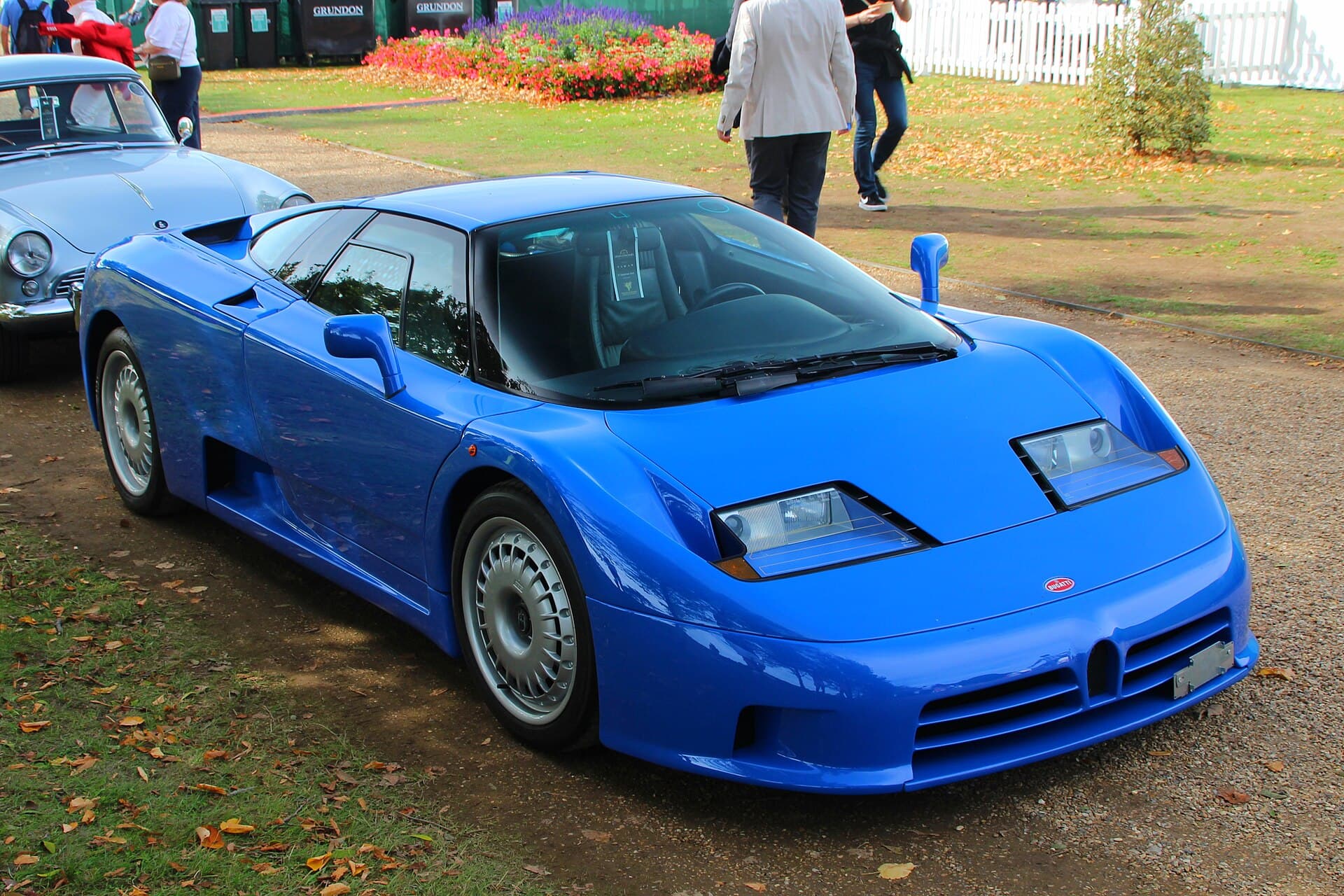
Bugatti EB110. Image: Calreyn88, Wikimedia Commons (CC BY-SA 4.0).
The Bugatti EB110 had four turbochargers, all-wheel drive and a carbon-fibre tub in 1991, years before its famous rivals caught up. It was the car that revived Bugatti, the fastest thing on the road when it launched, and a commercial disaster that bankrupted the company that built it. Michael Schumacher bought one. Only about 134 were made. Today it is a rising blue-chip that connects the prewar Bugatti to the modern Veyron, and it may be the most under-told story in 1990s supercars.
This piece is about the 1990s EB110, not the prewar Molsheim marque or the later Volkswagen-era cars, both of which iconcar covers elsewhere. Figures come from Bugatti, RM Sotheby's, Magneto and Hagerty, checked in August 2026. Where a production or price figure is contested, it says so.
What is the Bugatti EB110?
The EB110 is the supercar that revived Bugatti in the 1990s, built from 1991 to 1995 by the Italian entrepreneur Romano Artioli. Its name honours Ettore Bugatti, whose initials were EB, and marks 110 years since his birth; it was unveiled in Paris on 15 September 1991, his birthday, before a crowd of thousands. Artioli built it at a brand-new factory in Campogalliano, near Modena, in the heart of Italy's supercar country.
It is important not to confuse the three Bugattis. This is the middle one, Artioli's short-lived Italian revival, distinct both from the prewar French marque that built the Type 57SC Atlantic and from the Volkswagen-owned Bugatti that later built the Veyron. It is the bridge between them, and its story ends in bankruptcy after only about 134 cars.
What made the EB110 so advanced?
It out-engineered everything around it. The EB110 used a 3.5-litre V12 with 60 valves and four small turbochargers, drove all four wheels, and was built around a carbon-fibre monocoque made by the French aerospace firm Aerospatiale. Bugatti claims it as the first production car with a carbon tub; that honour is contested with the McLaren F1, but it got there first, unveiled a year before its British rival.
The performance backed up the ambition. The base GT made 560 PS and the lighter Super Sport 610 PS, enough for the SS to reach 351 km/h, or 218 mph, at the Nardo test track in 1993, which briefly made it the fastest production car in the world. Where the McLaren F1 chased purity through light weight and no turbos, and the Porsche 959 pioneered electronics, the EB110 threw every technology at once at the problem.
| Bugatti EB110 | Specification |
|---|---|
| Engine | 3.5L quad-turbo V12, 60 valves |
| Power | GT 560 PS / SS 610 PS |
| Top speed | GT 213 mph / SS 218 mph |
| Drivetrain | All-wheel drive, 6-speed manual |
| Chassis | Carbon-fibre monocoque (Aerospatiale) |
| Built | ~134 cars (about 95 GT, 39 SS), 1991–1995 |
Who designed and built the EB110?
The talent behind it reads like a supercar hall of fame. Marcello Gandini, who had drawn the Lamborghini Miura and Countach, styled the EB110, though his design was softened for production by Giampaolo Benedini, the architect who also designed the Campogalliano factory. On the engineering side, Paolo Stanzani started the project and Nicola Materazzi, the man behind the Ferrari F40, saw it through.
He spared nothing on the factory. The Campogalliano plant, known as the Fabbrica Blu, sat on a 240,000 square-metre site with its own test track and design studio, and was described at the time as the most modern car factory in the world. It was the physical expression of one man's lifelong dream to bring Bugatti back, and it would outlive the company by only a few years.
Why did Bugatti go bankrupt?
Ambition met the worst possible timing. The company filed for bankruptcy on 23 September 1995, after seven years of development and only four years of sales. The early-1990s recession gutted the supercar market, a strong yen and the Gulf War hurt exports, and Artioli's costly 1993 purchase of Lotus loaded the company with debt. By some accounts, suppliers were pressured to cut ties as well.
The human detail is the one that lasts. Artioli reportedly paid every one of his 220 employees to the final day, then watched the doors close. The leftover parts scattered into other projects, with Jochen Dauer completing a handful of cars in Germany and former staff building the B Engineering Edonis from unfinished chassis. The EB110 was too good to die quietly, and it did not.
Did Michael Schumacher own a Bugatti EB110?
He did, and his car is one of the most storied of all. In June 1994 Schumacher bought a yellow EB110 SS, chassis 39020, after testing it for a German magazine against the Ferrari F40, Jaguar XJ220, Porsche 911 Turbo and Lamborghini Diablo. He liked it enough to order the only Super Sport ever built with the plush leather interior of the GT, and he took delivery at the factory without asking for a discount.
The car led a dramatic life. Lightly used, it passed through specialists over the years, and in July 2021 it was among the rare hypercars caught in the German floods, photographed sitting in a flooded garage with mud in its sills. That a car owned by the sport's greatest driver, and nearly lost to a flood, survives at all only adds to the provenance that now drives its value.
What is a Bugatti EB110 worth?
Values have climbed into the millions, and the trend is steep. A standard GT now trades around 1.5 to 2 million dollars, while the rarer Super Sport runs from roughly 2.5 to 3.5 million. Both have compounded at about 10% a year over the long term, turning a car that sold for a fraction of that in the 2000s into a genuine blue-chip.
The records tell the story of the re-appraisal. A 616-mile Super Sport made 3.17 million dollars at Gooding's Pebble Beach sale in 2022, and in July 2026 an early GT prototype set a new high at 3.8 million dollars, up 71% from its own 2022 price in four years. The floor for a standard GT sits near 1.15 million. This is the same rise our guide to what makes a classic car worth millions traces, and the pattern we follow in classic car values in the EV era.
| Bugatti EB110 value (2026) | Figure |
|---|---|
| EB110 GT (typical) | ~$1.5M–$2M |
| EB110 SS (typical) | ~$2.5M–$3.5M |
| Super Sport (616 miles) | $3,167,500 (Gooding, 2022) |
| GT prototype (record) | $3,806,250 (July 2026) |
How does the EB110 connect prewar Bugatti to the Veyron?
It is the missing link in the Bugatti story. When Artioli's company failed, Volkswagen bought the Bugatti name in 1998 and set about building the Veyron, whose recipe of massive forced induction and all-wheel drive is exactly the formula the EB110 pioneered. The technical thread runs straight from Campogalliano to Molsheim.
There is a charming footnote that closes the circle. By Bugatti's own telling, Volkswagen chairman Ferdinand Piech decided to revive the marque after his young son insisted on buying a model of a prewar Bugatti Type 57SC Atlantic on a family holiday. The car that iconcar covers as the prewar high point therefore helped inspire the modern Bugatti, and the EB110 is the ambitious, doomed chapter that sits between them. Being too early is often how the most interesting cars are made.
Frequently asked questions
How many Bugatti EB110s were made? About 134 in total between 1991 and 1995, roughly 95 GT and 39 Super Sport by Bugatti's own count, though tallies vary once prototypes and cars finished after the bankruptcy are included. Production ended when the company collapsed in September 1995.
Did Michael Schumacher own a Bugatti EB110? Yes. He bought a yellow EB110 SS, chassis 39020, in 1994 after testing it against its rivals, specifying the only Super Sport built with the GT's leather interior. The car was later damaged in the 2021 German floods.
How much is a Bugatti EB110 worth? A GT typically runs 1.5 to 2 million dollars and a Super Sport 2.5 to 3.5 million. The record stands at 3.8 million dollars, set by an early GT prototype in July 2026, with values rising around 10% a year.